Nuts & Bolts Vol 19 15cm s.IG33 (Sf) auf Pz.Kpfw. I Ausf. B
The development of the 15 cm schwere Infanteriegeschütz 33
The issuing of the schwere Infanteriegeschütz 33 with the Reichswehr and its later use with the Wehrmacht goes back to the development of a 15,24 cm mortar conducted by Rheinmetall in 1927 on an instruction of the Inspektion der Artillerie In 4. In its final form the gun was issued to the Reichswehr in 1933. From this date until the war’s end this piece of artillery ordnance remained largely unchanged. Five different version of the guns were put into service:
- s.I.G. 33 horse-drawn (variant 1933)
- s.I.G. 33 horse-drawn (variant A)
- s.I.G. 33 horse-drawn (variant B)
- s.l.G. 33 motor vehicle-drawn (variant A)
- s.l.G. 33 motor vehicle-drawn (variant B)
As only variants 2 and 4 were commonly used during WW II, this volume will concentrate on these two versions.Studying these guns, one can see that the main difference with these guns are only the wheels. While the horsedrawn guns were built with iron wheels, the guns for mechanized towing were built with full rubber wheels.During the war wooden spoked wheels with full rubber
rims were developed. With the use of timber wheels the savings in steel could be put to other more important war requirements. All in total four different wheel variants can be seen on photos. It’s not known if this also let to some weight saving which would have eased towing the gun.Also it remains unknown if the spring leafs of the horse-drawn version were directly discontinued with the development of the version for mechanized towing. However, their holders were kept with the guns, as it can be seen from museum vehicles. During the war, possibly because of material shortages, the following changes, especially of the gun barrel, can be found with the gun:
(i) Changes to the wheel deflector and the abutment for the auxiliary elevating beam using welded steel plates
(ii) Changes to the breech ring. The frontal area of the breech ring is rounded, and flat at the sides, the eye rings at the breech are dropped.
(iii) The edges of the breech ring are nor longer rounded, but broken.
This Nuts an Bolts title by Jürgen Wilhelm is in the series’ revised format and features an extensive 160 A4 pages with approximately 375 photos, plus colour profiles and scale drawings with text in both German and English. David Parker, who is behind AFV Modeller, was responsible for designing the graphics layout. Overall I found the layout was professional, and logically structured for ease of reference. For example related photos are grouped together and all the background chapters are clearly and systematically written. The photos vary in size, with 3 photos per page, and the captions are informative in pointing out key features.
The opening pages provide background material on both the towed gun (1.5 pages in English) which includes explanation of the five main variants and also the ‘Bison’ self-propelled gun (4 pages in English plus charts etc) . The later is described in considerable detail and includes the technical development and specifications, deployment, camouflage and markings, and a table accounting for known photos of each specific vehicle by campaign. A one-page diagram visually presents the order of battle for a company equipped with the self-propelled gun and accompanying half-tracks, trucks, cars and bikes. Given the limited references previously available on these subjects, most readers will find much new material in this section.
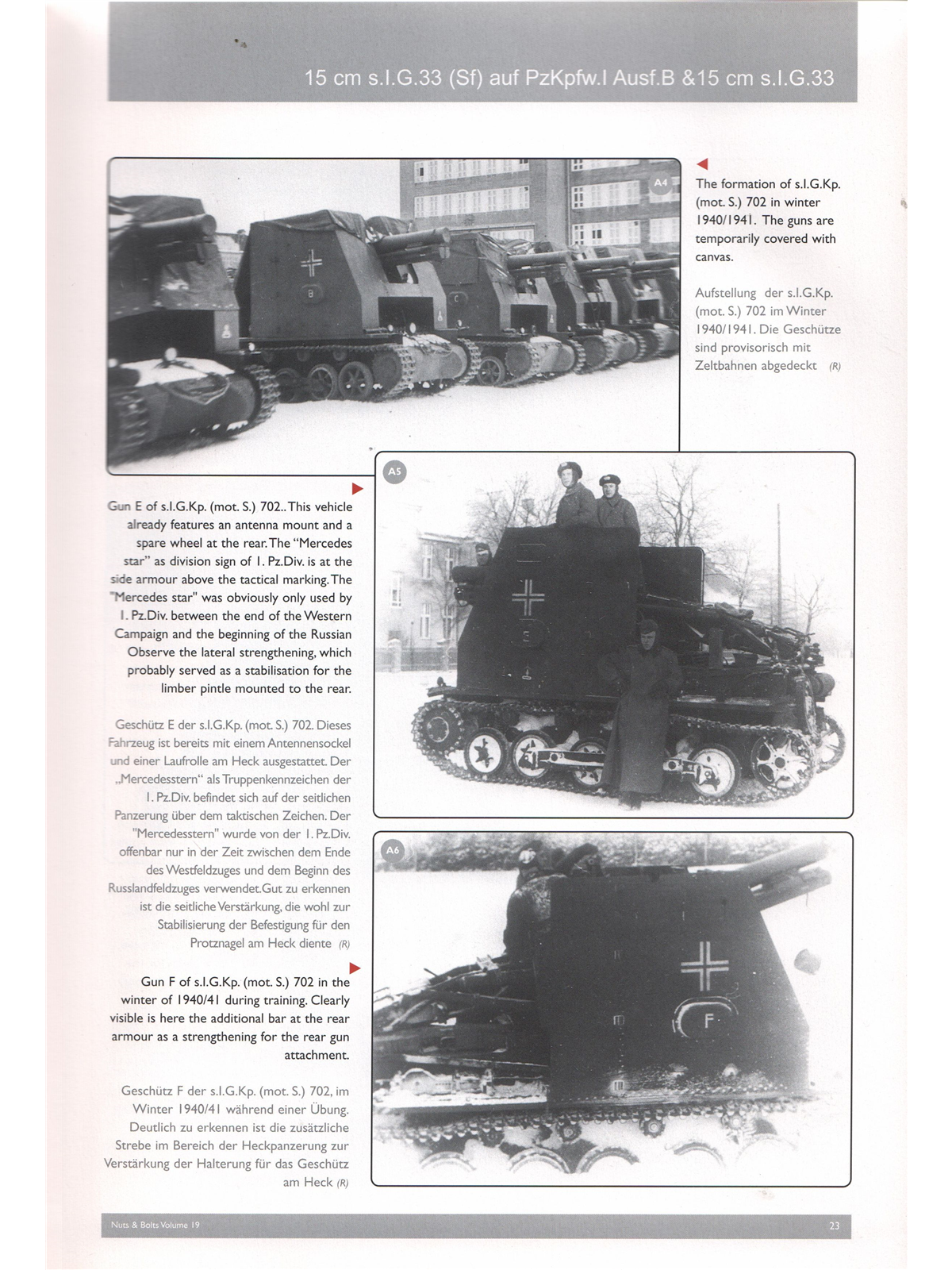
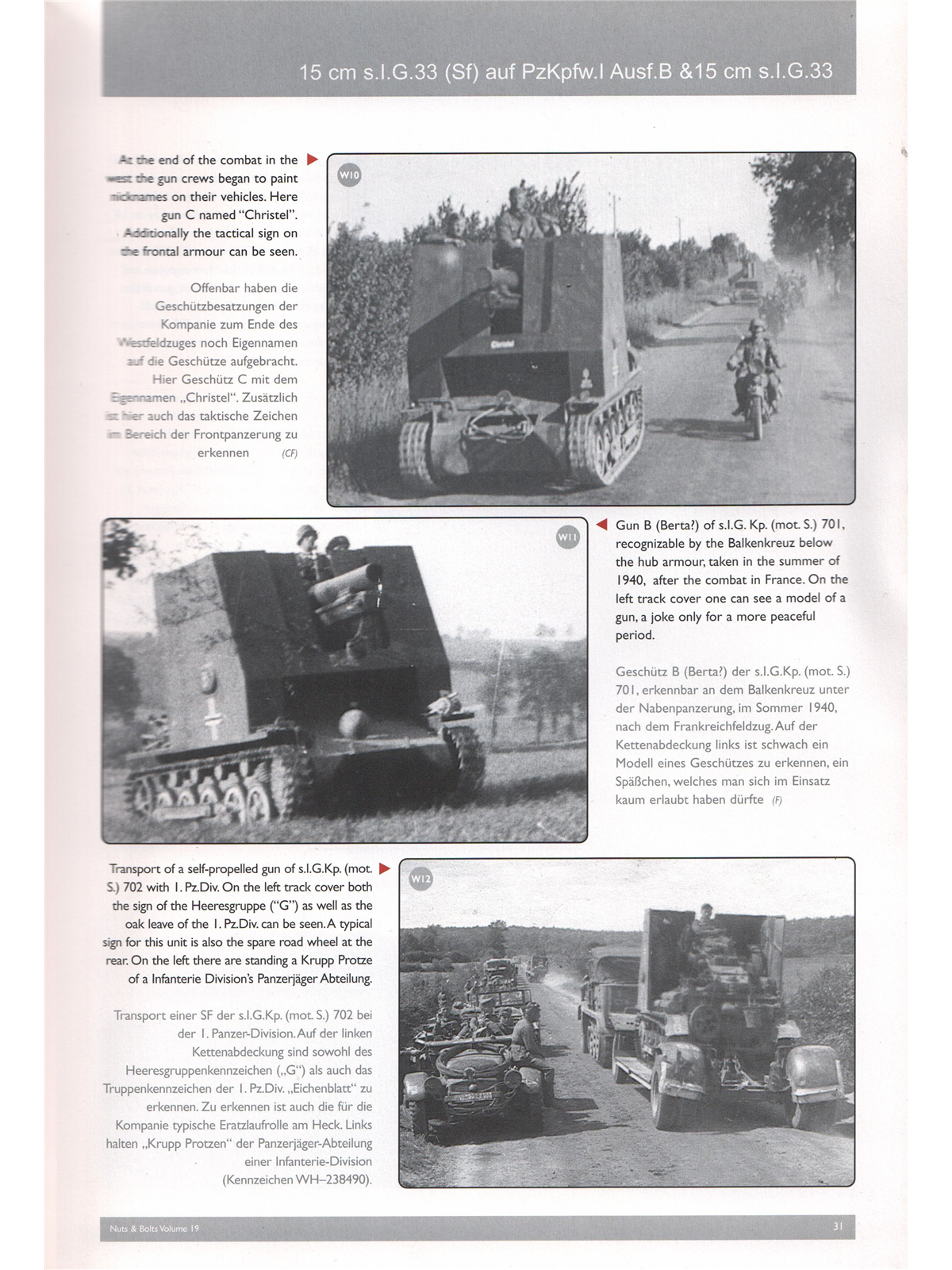
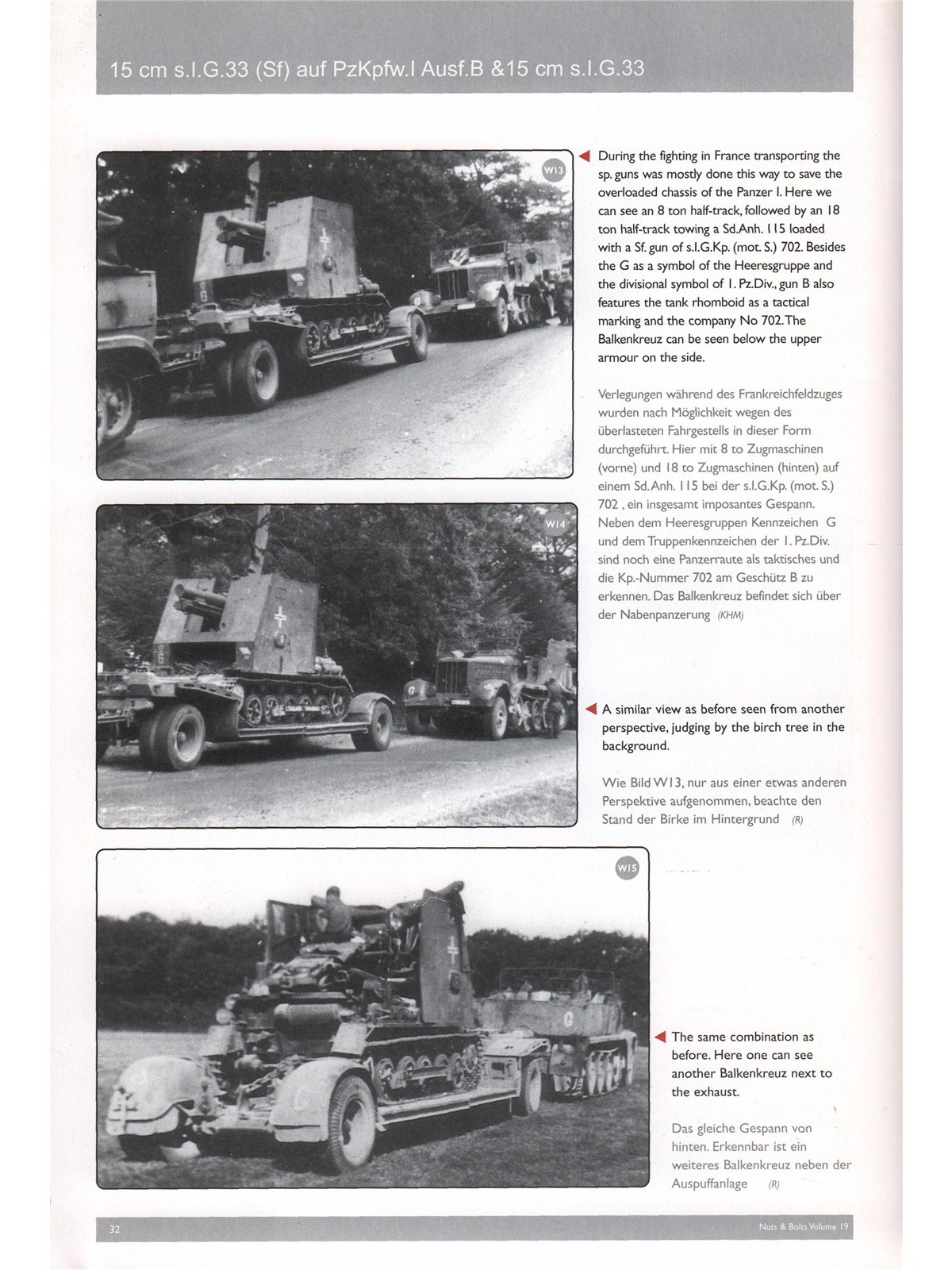
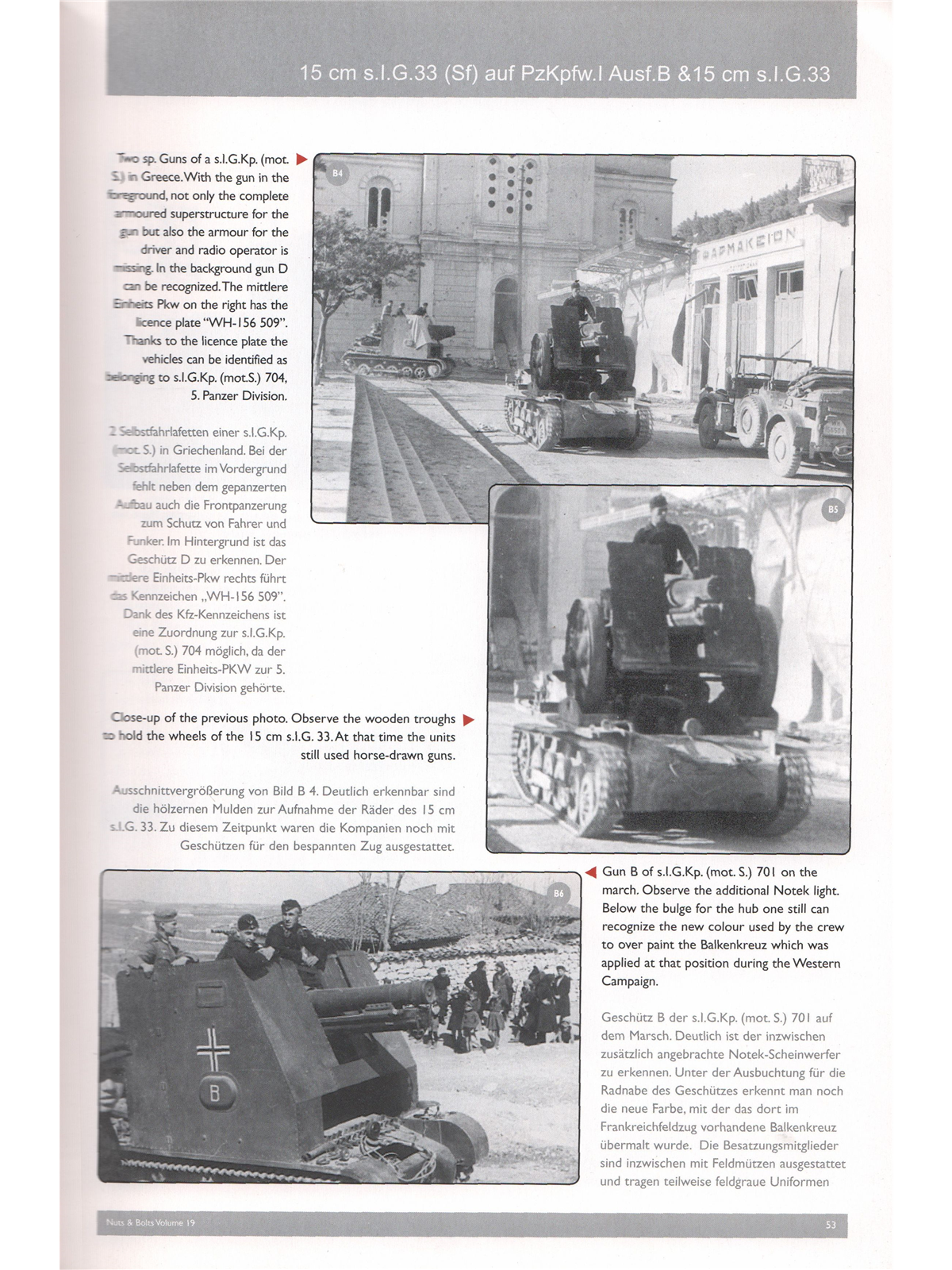
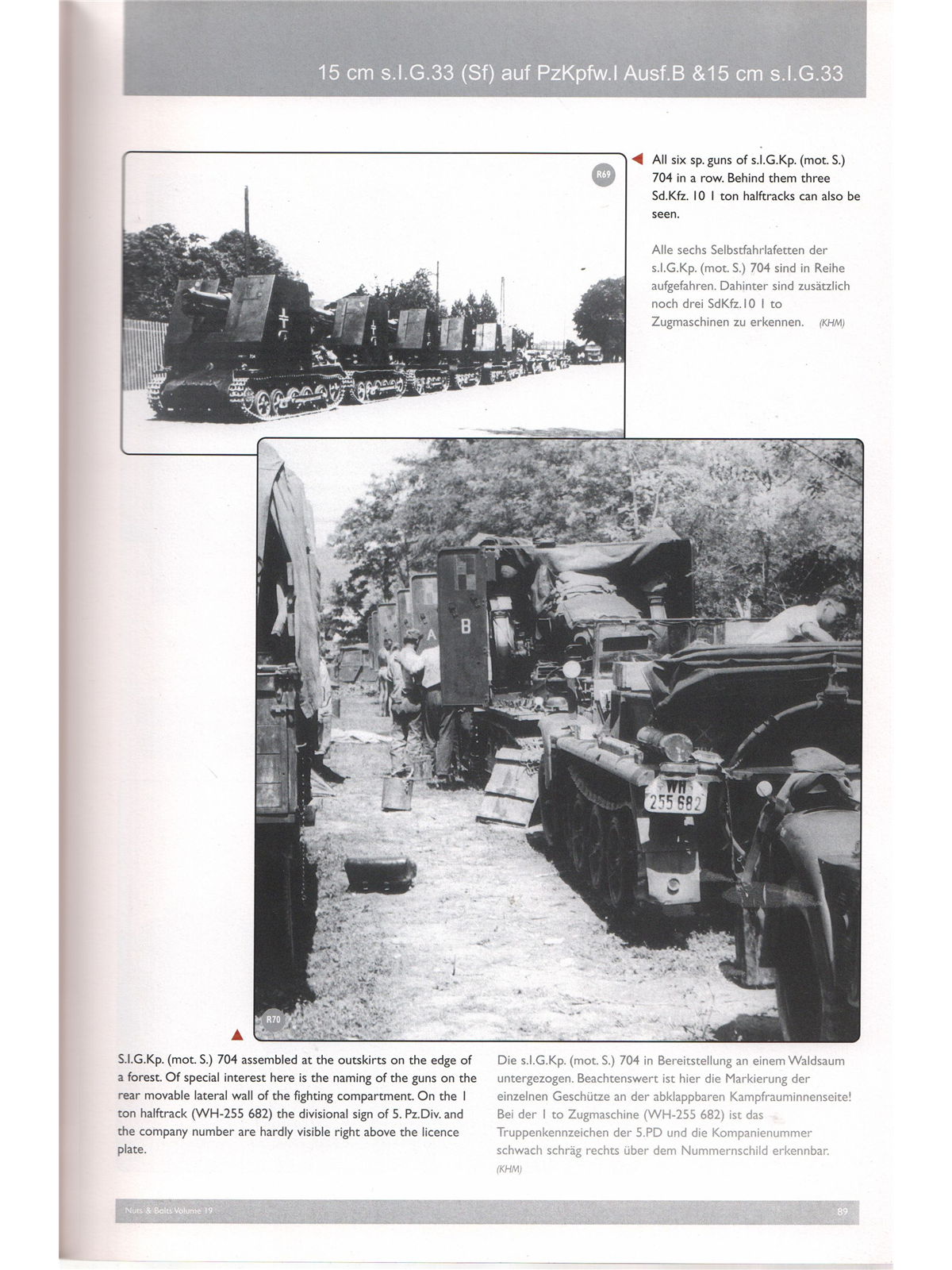
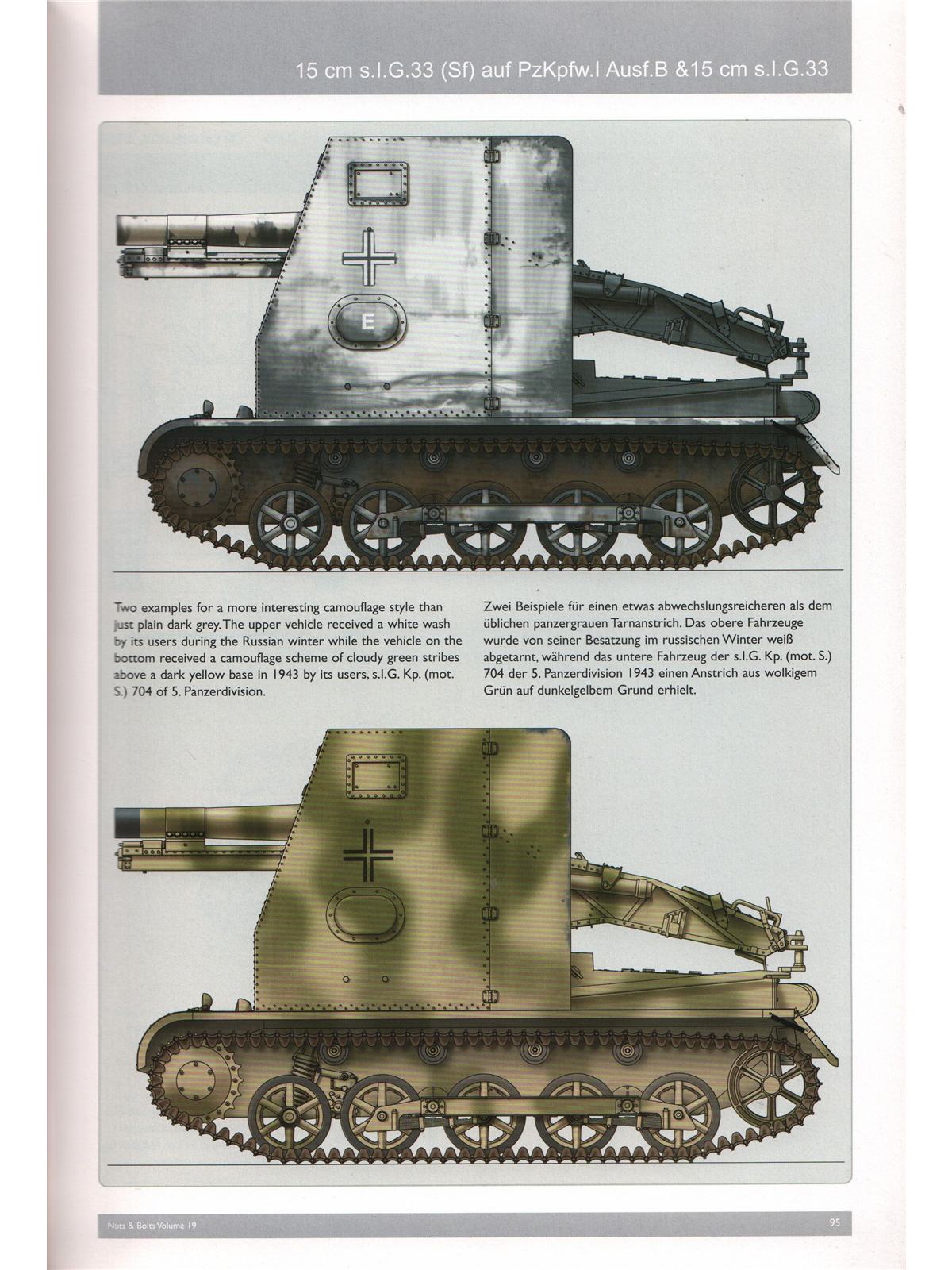
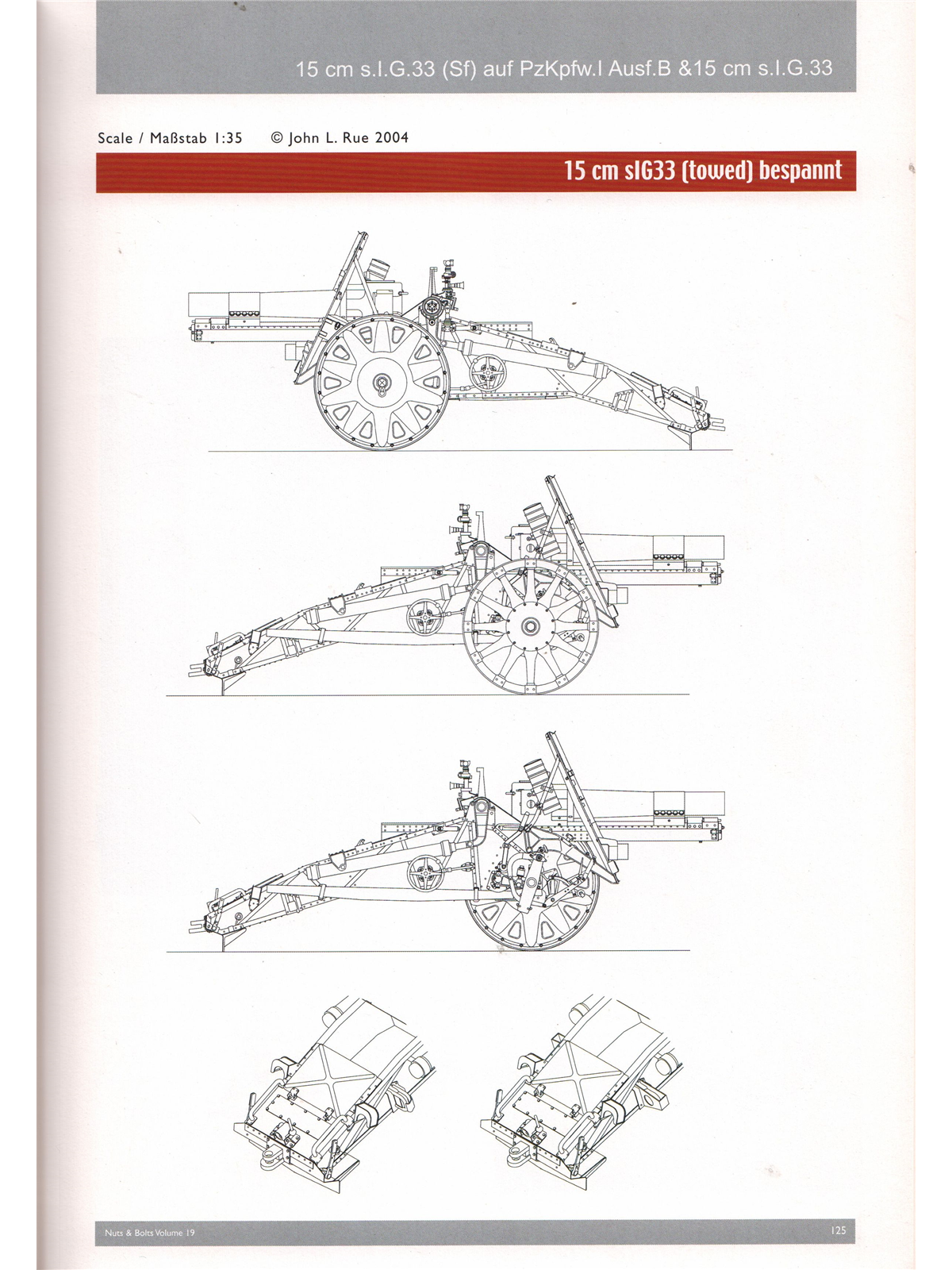
Sixty-nine pages present a chronological visual history of the self-propelled gun, which included many photos that were new to me. These b/w photos tend to be of the vehicle’s exterior and provide much detail on the external fittings, hull, markings and how the crew’s adorned them, but unfortunately there is limited coverage of the interior layout. As there are no surviving examples, there are no photos of a museum vehicle. The in service photos also cover the accompanying soft-skinned vehicles especially the 1 tone Sdkfz 10 Demag half-track (available as 1/35 model from Italeri). Five pages of colour profiles depict six different vehicles with between one and three views each. These profiles are based on photos in the book. John Rue provides four pages of 1/35 scale plans with five views, two cut away plans and three sketches of key detail, which would be useful to modellers, especially those who are scratch-building the superstructure.
The towed 150mm sIG is covered with twenty-four pages of b/w wartime photos that illustrate the different versions of the gun. These photos show how different versions of the gun were towed by horses or vehicles, such as 1 ton Sdkfz 10, and 3 ton Sdkfz 11 and 251 series, half-tracks. Other photos cover the gun being operated by the crew on the front line. Colour photos of several surviving guns are included to show close-up detail from almost every angle and would also be useful when detailing the gun either as a towed version or when mounted on the Panzer I B. Again John Rue provides scale plans and line sketches of features such as the various types of breech.
Seven in progress and completed colour photos cover a 15cm sIG 33 (Sf) auf PzKpfw.1 B (Bison) by Tony Greenland which was built by combining the hull from the Italeri Panzer I ausf B and a Pit Road white metal sIG 33. Alan Hobby have released a 1/35 model of the ‘Bison’, but its standard is typical of many Russia kits and it would benefit from extra detailing and/or the replacement of the hull with one from the new Dragon Panzer I ausf B. New Connection’s conversion set for the Italeri kit includes the Alan sIG 33 gun and resin pressed-steel wheels.
Nuts & Bolts Jurgen Wilhelm Nuts & Bolts