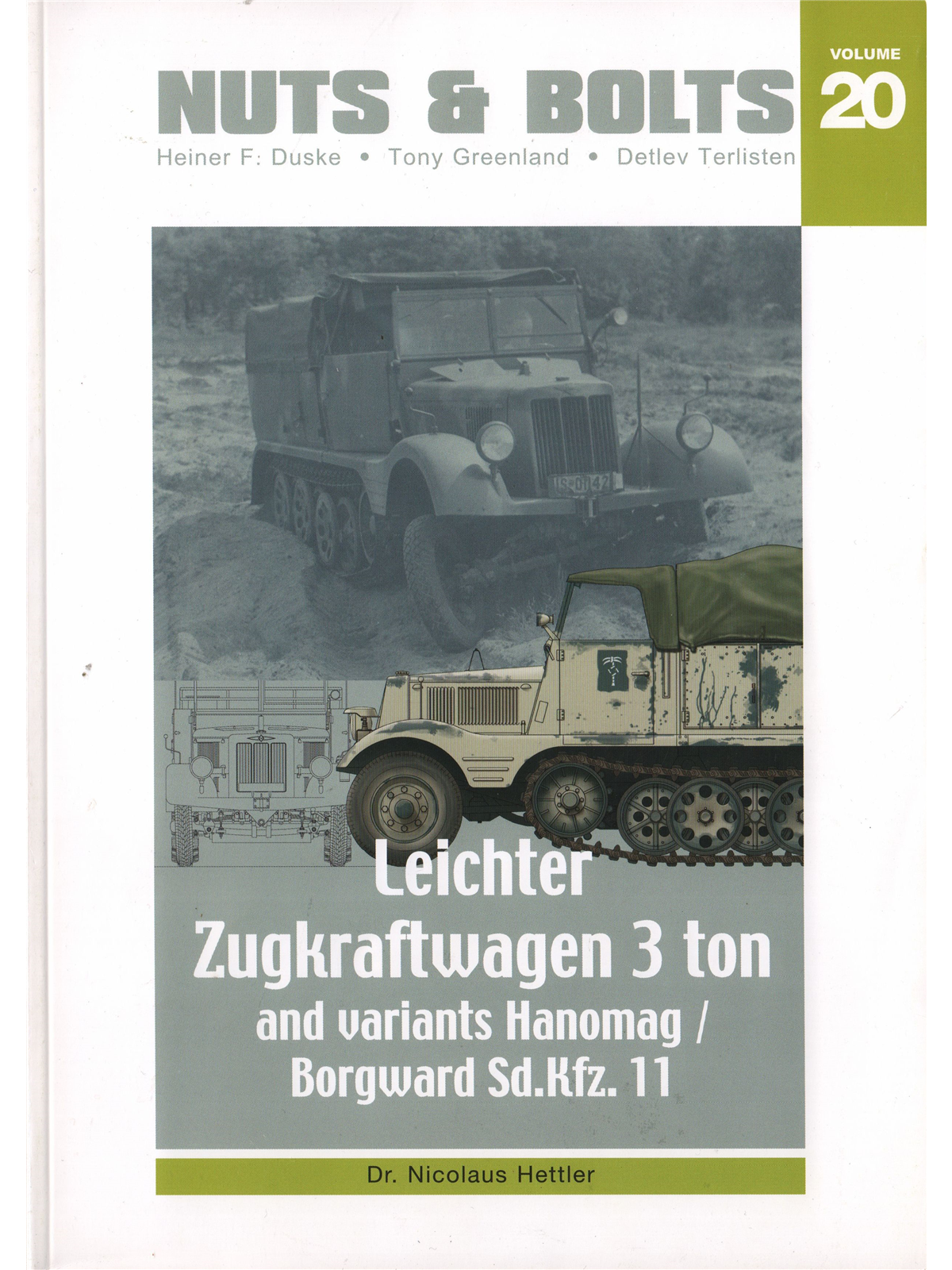
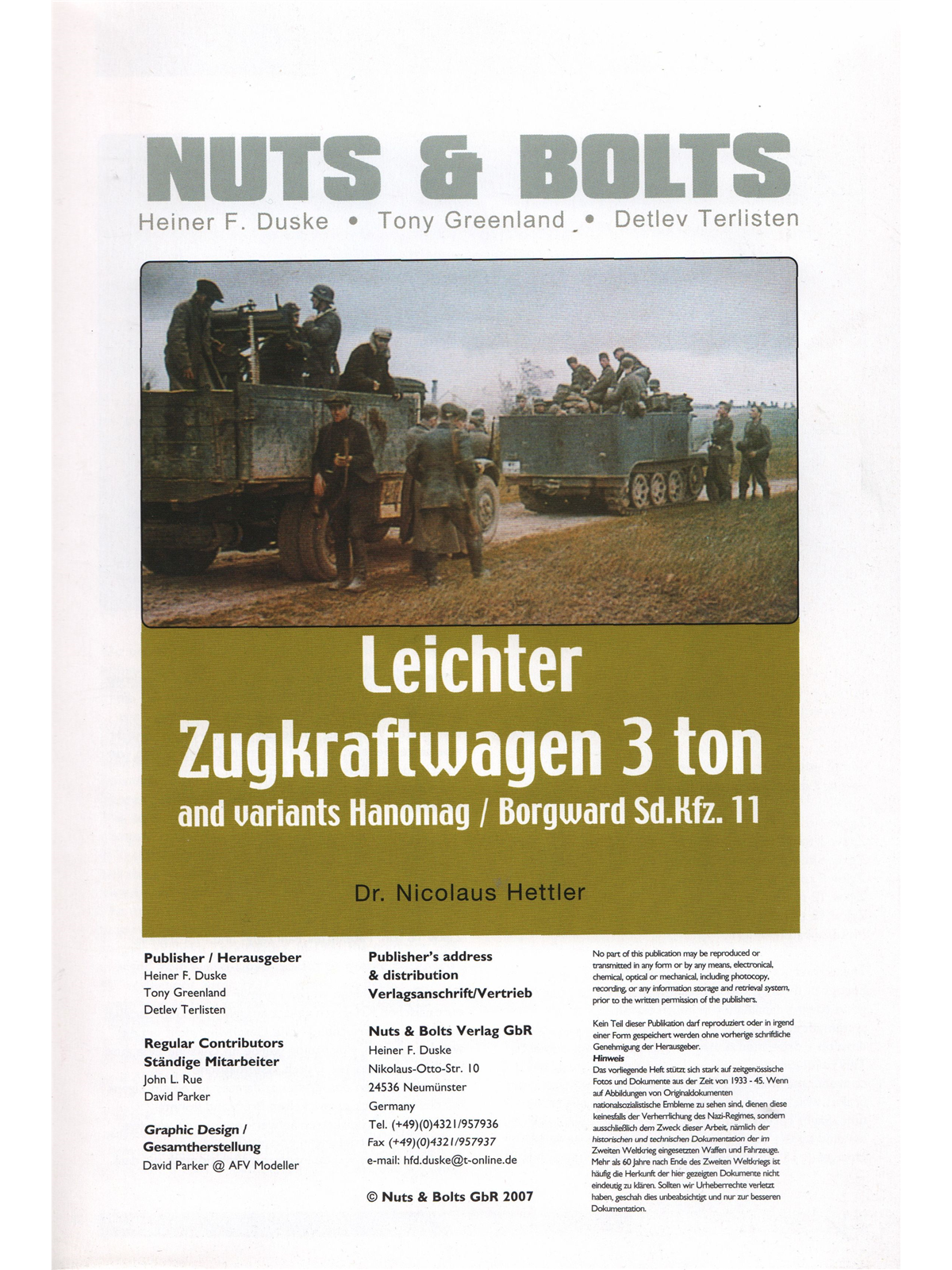
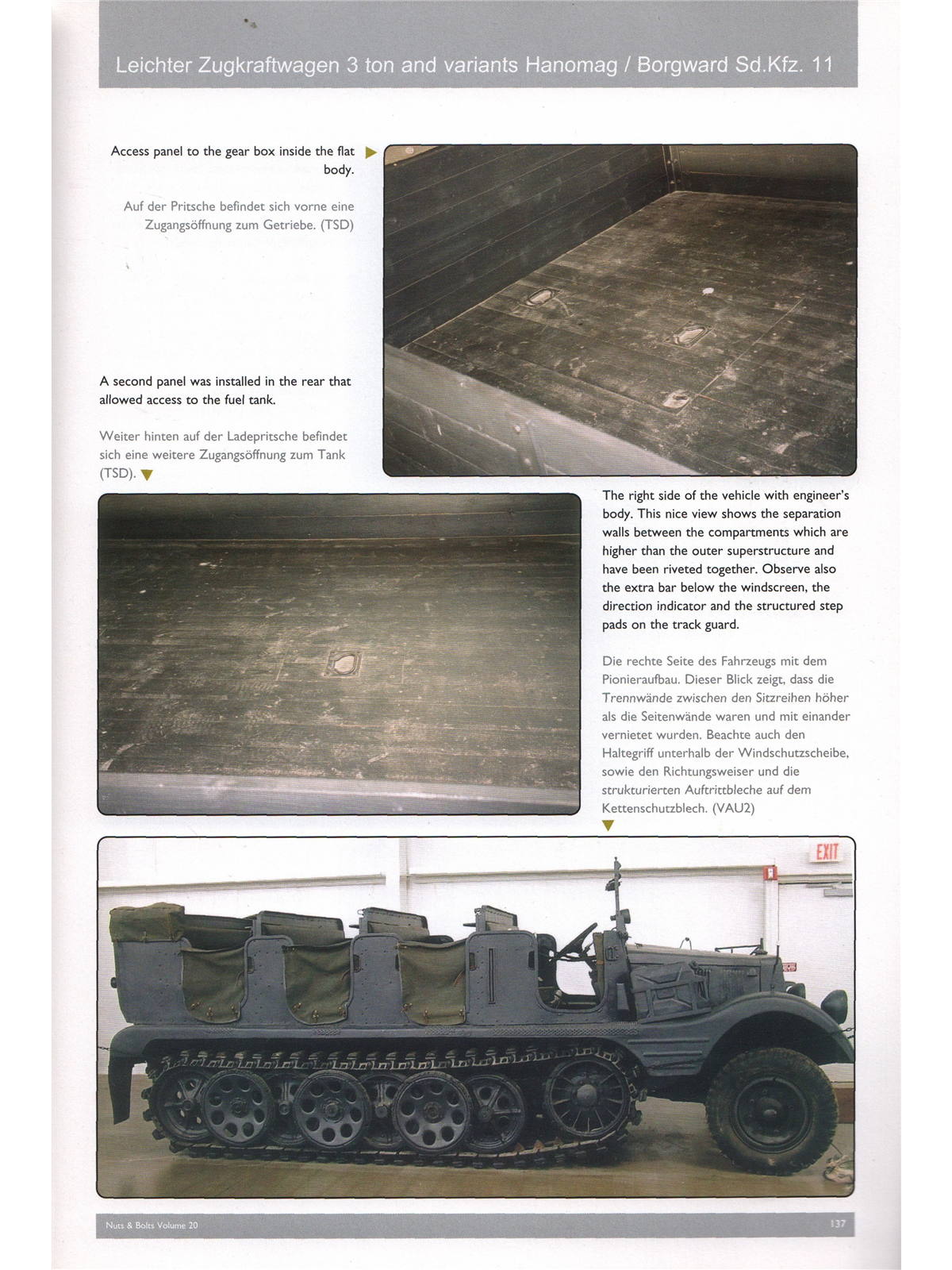
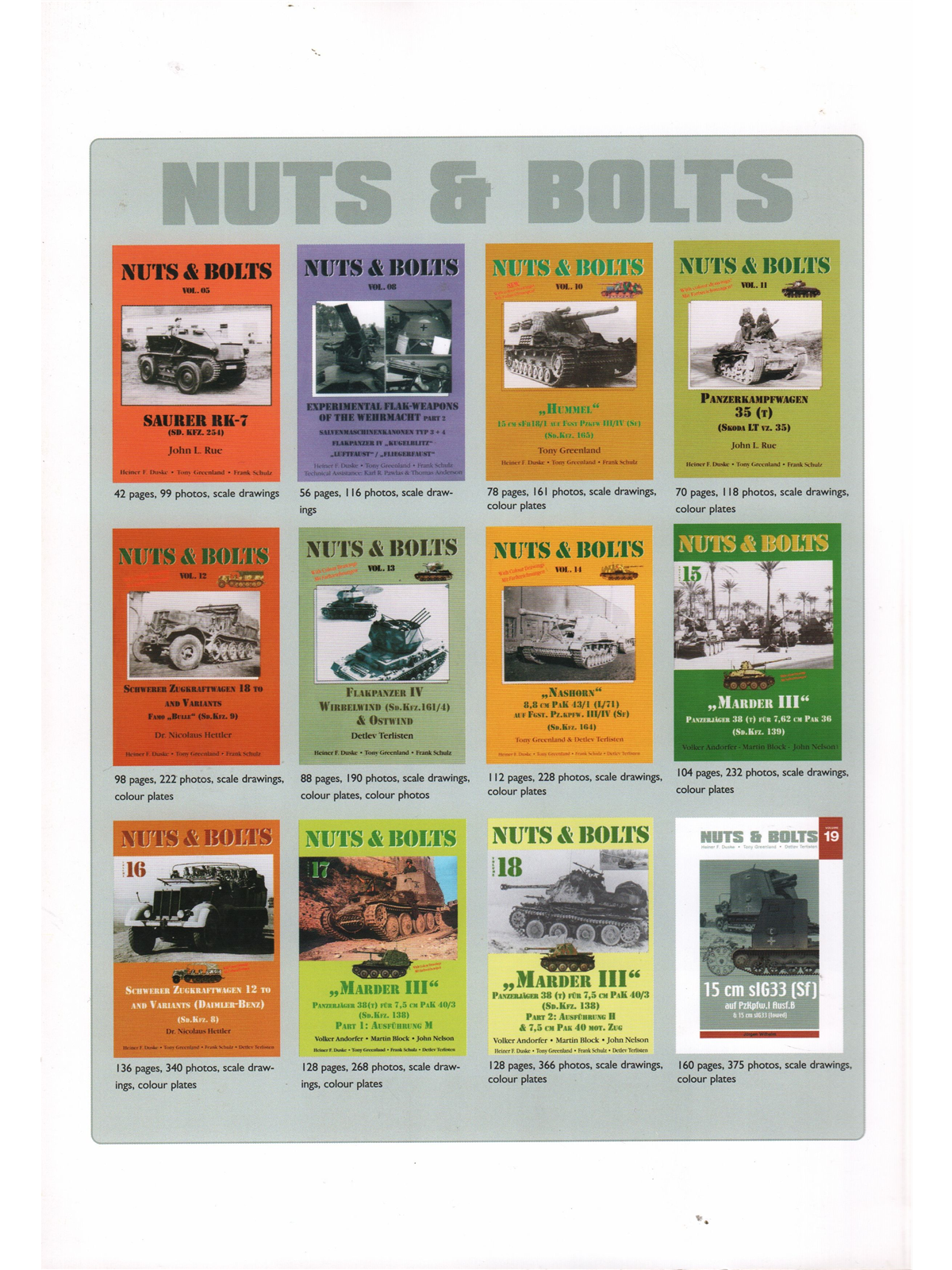
Nuts & Bolts Vol 20 leichte zugkraftwagen 3 ton sdkfz 11
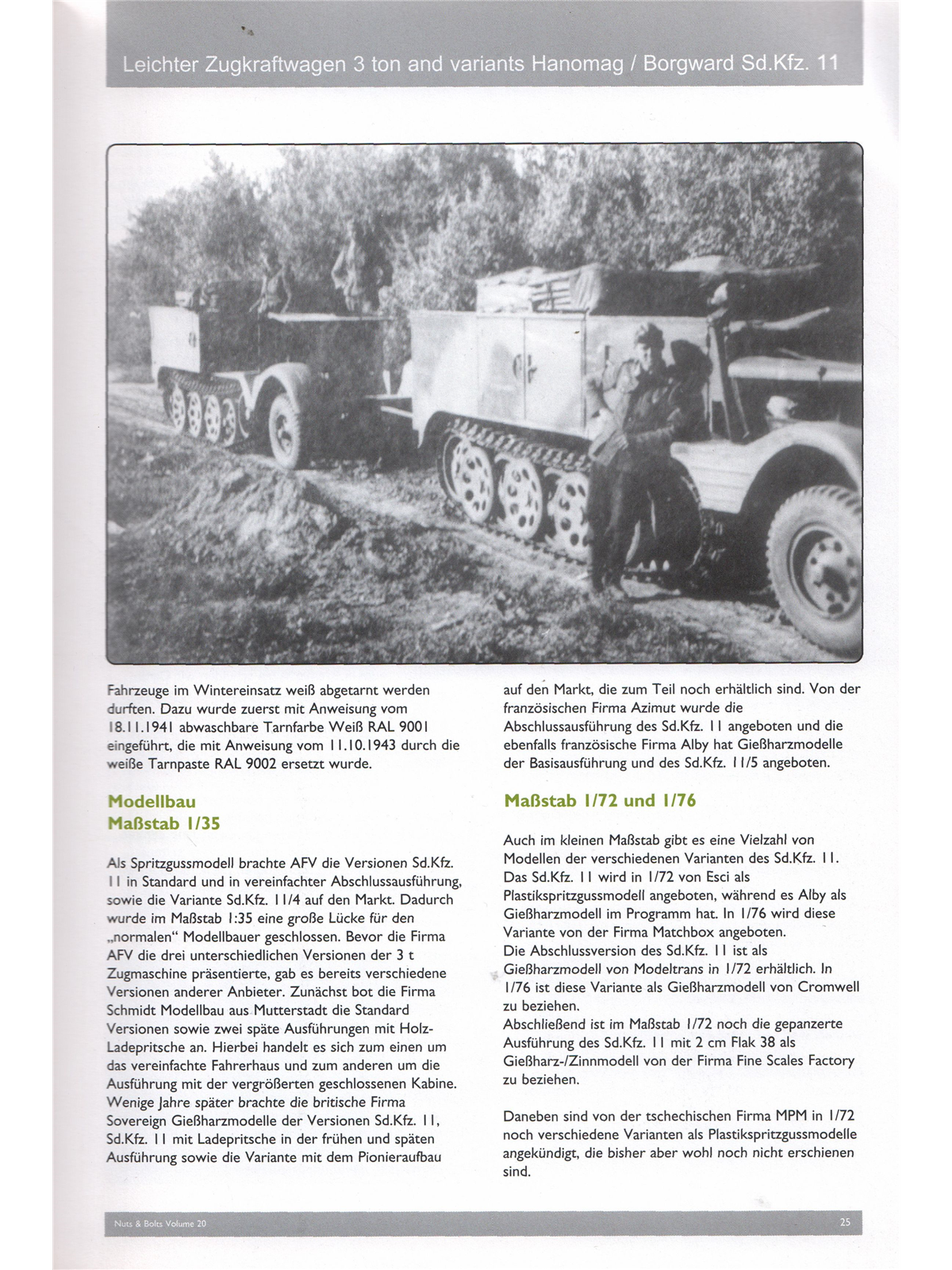
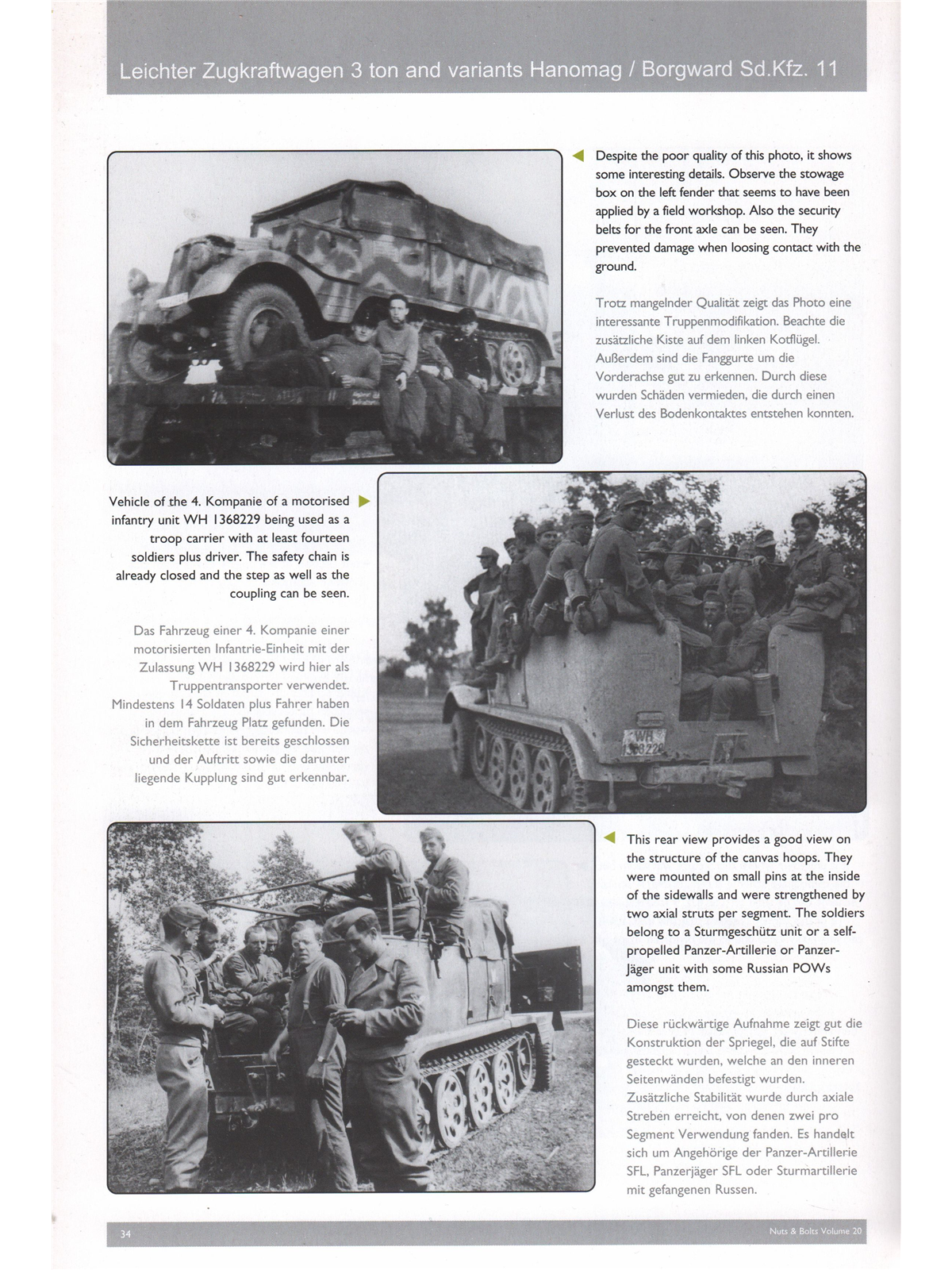
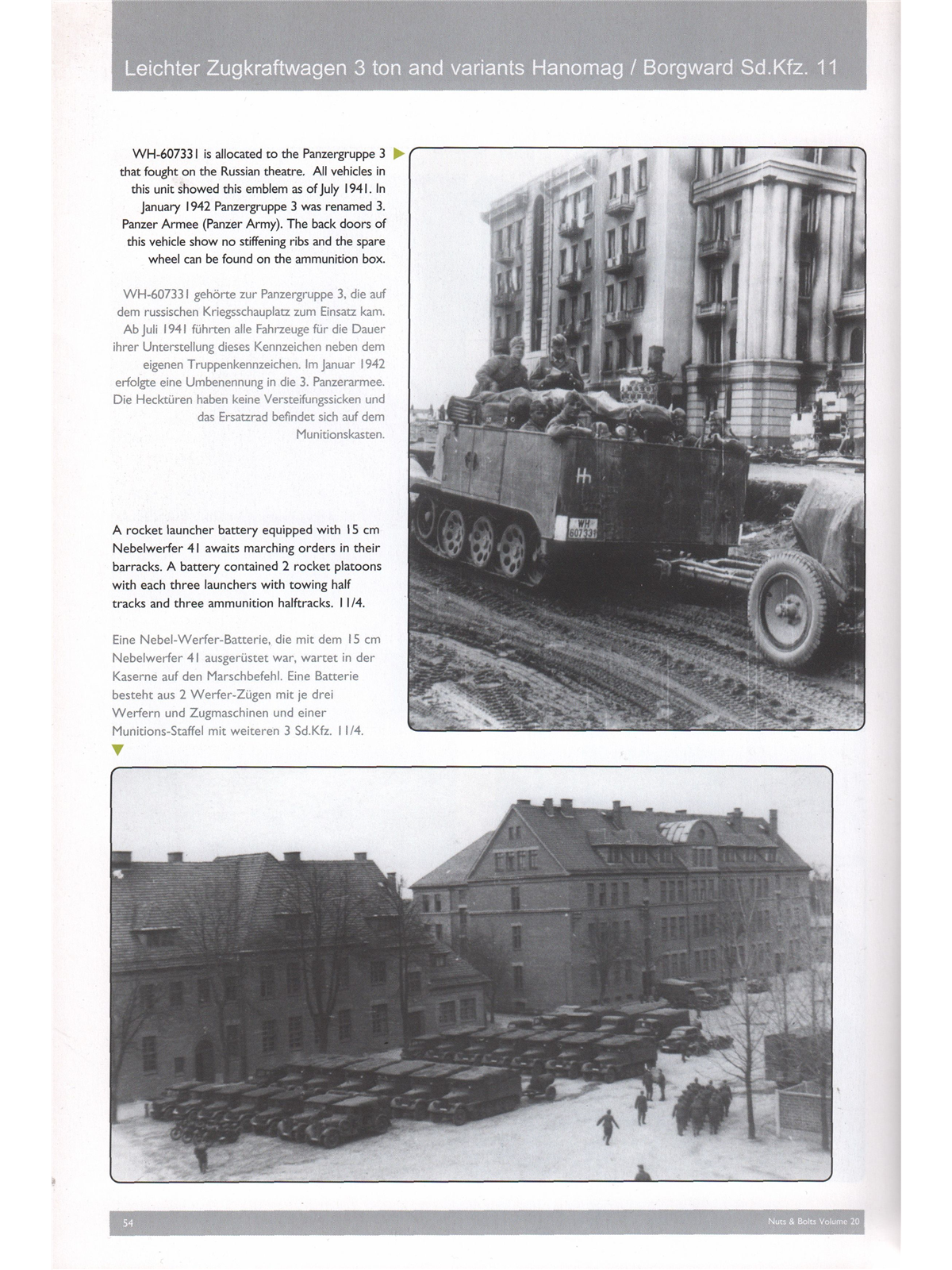
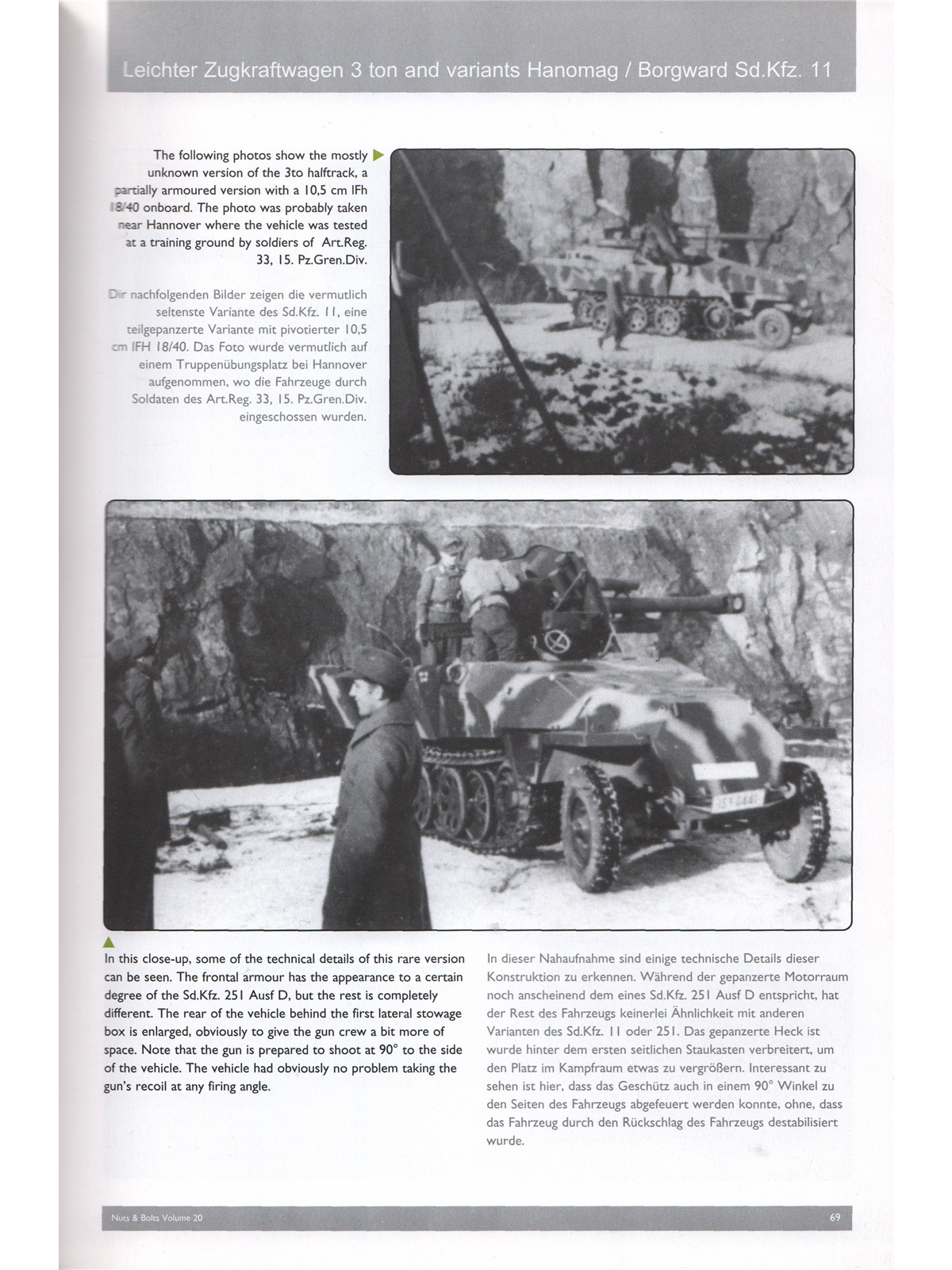
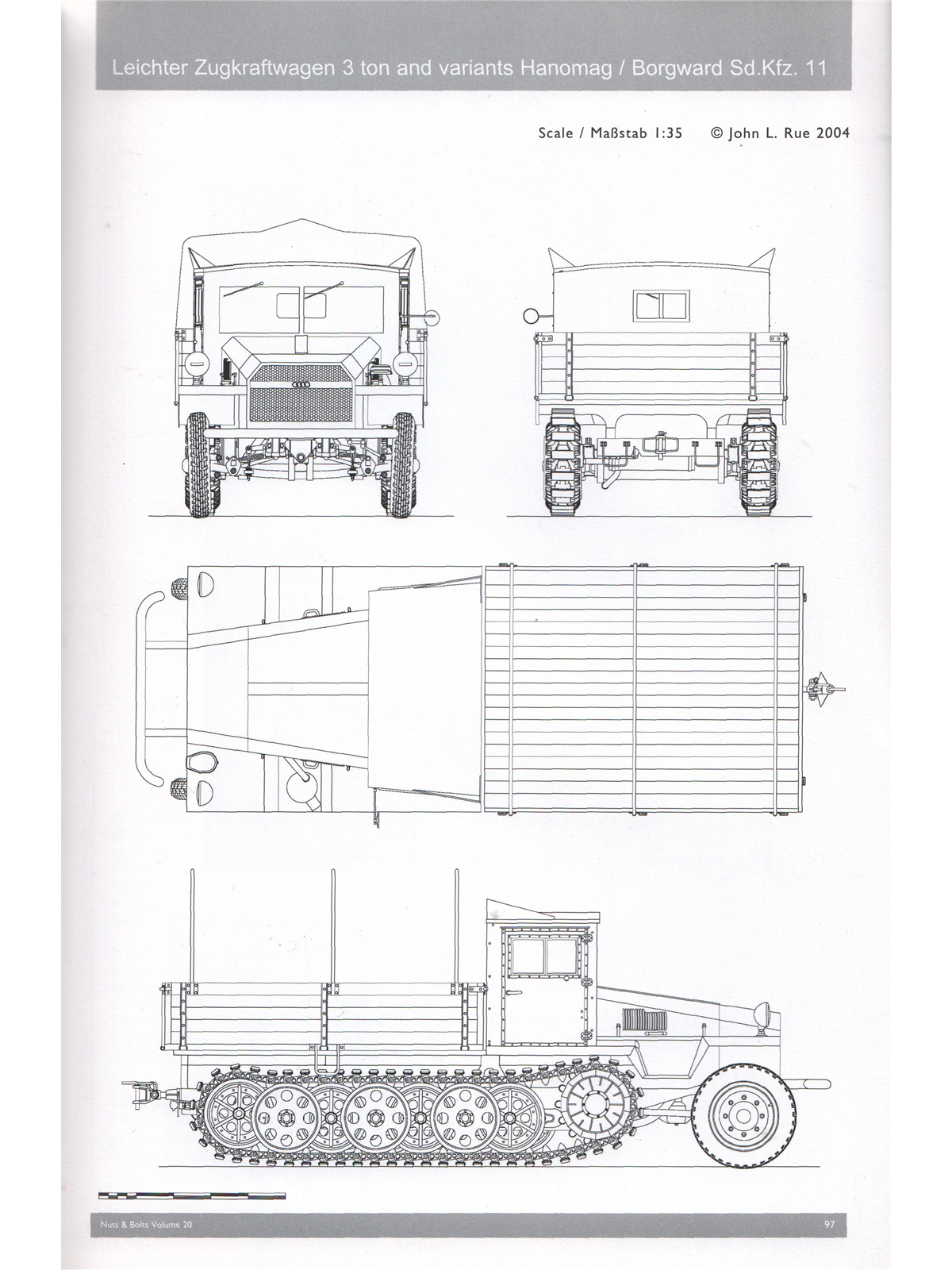
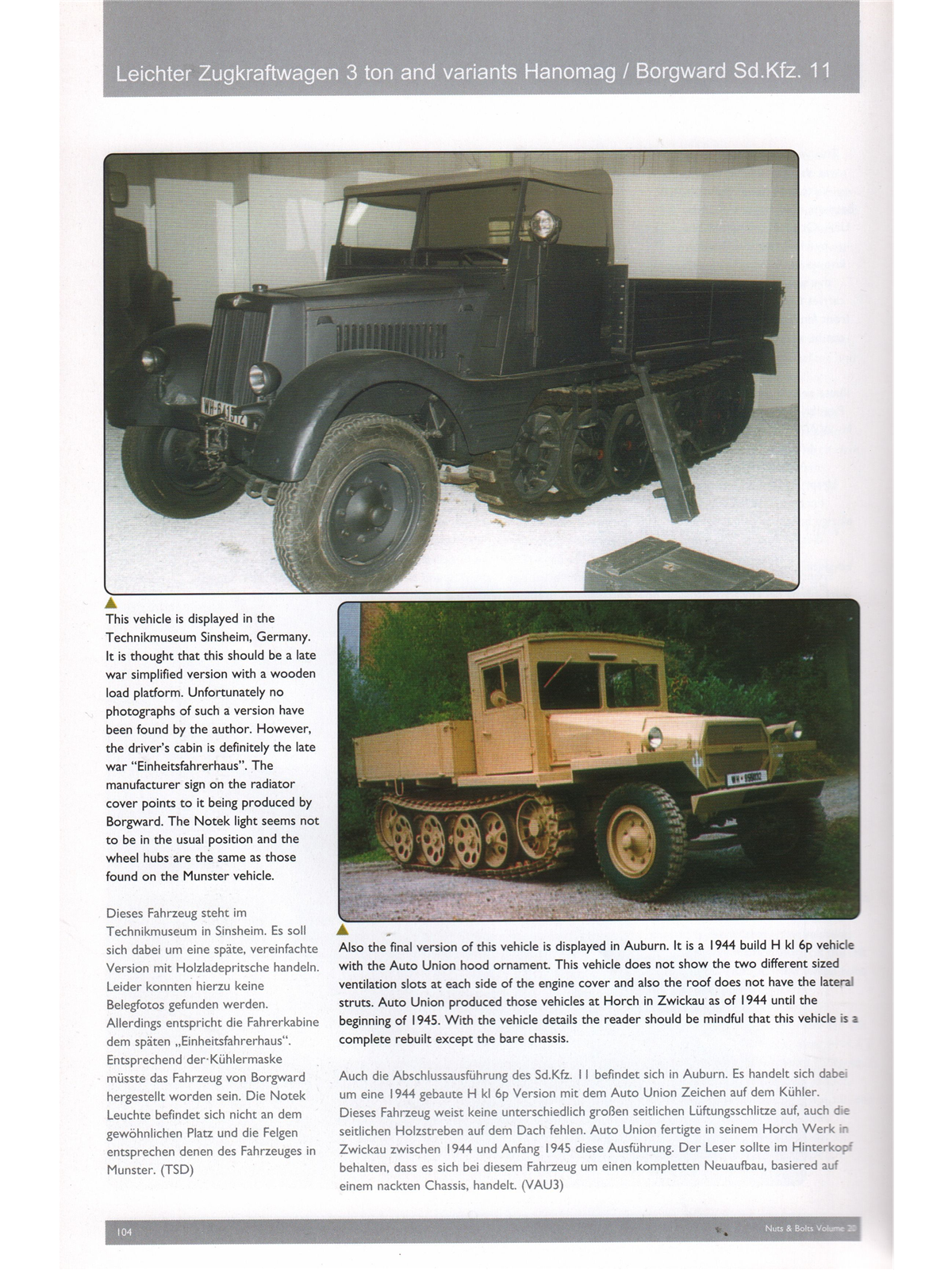
This edition of the “Nuts & Bolts” series covers the 3 ton light tractor in all known versions – Hanomag/Borgward Sd.Kfz. 11. It contains 265 photos on 144 pages. Of these, 130 photos show contemporary images of the self-propelled gun and 76 of the 15 cm sIG33 as a towed gun (most of them unpublished). 124 color photos show still existing examples in great detail. 10 color photos present an award-winning 1:35 scale model built by Tony Greenland. The text, which takes up 25 pages, is in English/German, as are the captions. 20 scale drawings (in 1:35) and 3D views of all versions, as well as 6 color plates with various camouflage schemes for the various versions, round off the booklet.
Introduction
During World War Il no other army used such a wide variety of half tracked vehicles as the German Wehrmacht. Based on the experience of World War | and the succeeding Reichswehr, a first generation of half tracked tractors was developed by various sponsor companies. In total 6 different vehicles, defined by their towing capabilities, were introduced:
- Zgkw | ton: Proposed Company Demag
- Zgkw 3 ton: Proposed Company Hansa Loyd
- Zgkw 5 ton: Proposed Company Biissing NAG
- Zgkw 8 ton: Proposed Company Krauss-Maffei
- Zgkw 12 ton: Proposed Company Daimler Benz
- Zgkw 18 ton: Proposed Company Fahrzeug- und Motorenbau (FAMO)
These tractors had been developed primarily for the European theatre, which meant high speed on roads and good towing capabilities in rough terrain. Only by systematic trials at the Waffenpriifamt was it possible to develop a drive mechanism that met both requirements. This revolutionary steering system was a mixture of a conventional steering gear on the front axle and steering
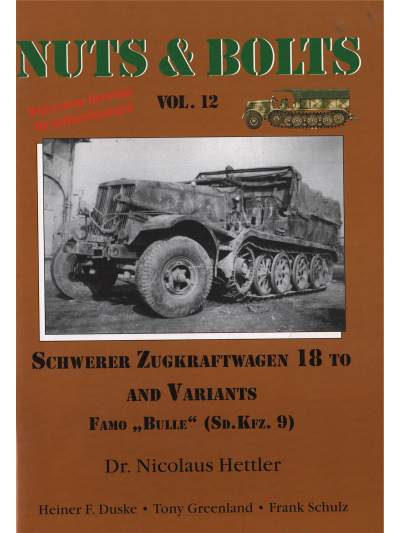
brakes which acted upon one side of the tracks at a time. Slight curves and corrections during travel were handled by the front wheel steering. Whenever larger changes (>15°) of direction were necessary, the running gear brakes were activated. A more detailed description of the development history can be found in previous Nuts& Bolts volumes; in particular numbers 12 and 16 which cover the 18 ton and 12 ton halftrack. Although those vehicles set the standard in different aspects; e.g. high speed on roads combined with high towing capability they also later caused difficulties. This was due to the fact that six different vehicles had to be procured and maintained all at the same time.
An appraisal showed that two types of tractor would become redundant. The critical situation of raw material procurement led to the development of the light Wehrmachtsschlepper (replacement for | tonne and 3 tonne vehicles) and the heavy Wehrmachtsschlepper (replacement for 5 tonne and 8 ton prime-movers).
The light Wehrmachtsschlepper was developed by Adler Werke in Frankfurt, however the vehicle never saw series production. The specification requirements were fulfilled by the Raupenschlepper Ost (RSO). Biissing AG who was responsible for the heavy Wehrmachtsschlepper delivered approximately 1,000 units to the Army.